Building the Next Phase of Culture Change: Highlights from the Winter 2025 CTDOC/IMRP/Amend Summit
On December 16, 2025, more than 40 leaders and staff from across the Connecticut Department of Correction (CTDOC) gathered at UConn Hartford for Day 1 of the Winter 2025 Culture Change Summit. The two-day summit, convened by the Institute for Municipal and Regional Policy (IMRP) in partnership with Amend at the University of San Francisco, supports Connecticut’s ongoing efforts to advance a safer, healthier, and more effective correctional culture.
Over the past year through the IMRP’s International Justice Exchange, CTDOC cohorts have traveled to Norway, the United Kingdom, Washington, Oregon, and California to learn from correctional systems leading innovative reform efforts. Those international learning experiences, combined with pilot initiatives at York and Garner Correctional Institutions, have helped establish a shared foundation for culture change grounded in staff safety, wellness, and empowerment. Core principles such as normalization, security, and progression have guided this work, with the goal of improving outcomes for both staff and incarcerated individuals.
The summit brought together CTDOC leadership, facility-based teams, training staff, and partners to align around a shared purpose, deepen collective understanding, and begin shaping actionable recommendations for 2026.
A Day of Shared Learning and Reflection
The day opened with welcoming remarks from IMRP and Amend leadership, setting expectations for collaboration and framing the summit as a bridge between learning and action.
The morning featured cohort presentations from teams representing Garner CI’s CREW, York CI’s CORE, the Maloney Training Academy and Training-for-Trainers (T4T) program, and normalization teams from both York and Garner. Each group reflected on key international learning moments, how those insights are shaping their work, progress made at the site level, and the obstacles and opportunities ahead. Together, the presentations painted a picture of meaningful momentum, alongside clear areas where continued investment and coordination will be essential.
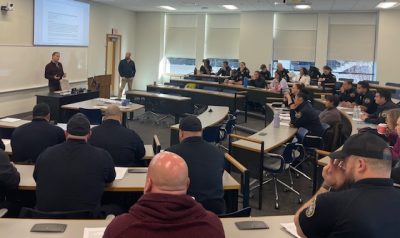
A guided discussion followed, surfacing common themes and preparing participants for the afternoon’s hands-on work.
Turning Insight into Action
After lunch and informal networking in the Hartford Times Building atrium, participants moved into Innovation Labs, rotating through two facilitated workgroups focused on translating ideas into concrete next steps. Across four topic areas, each lab developed three to five actionable recommendations, noting feasibility considerations and resource needs.
The Innovation Labs focused on:
-
Staff Training and Professional Identity, exploring how training can more fully support culture change and how trainers can serve as change agents.
-
Resource and Activity Team Expansion, identifying ways to strengthen and grow existing teams while engaging more staff in the change process.
-
Normalization and Environmental Transformation, examining practical, no-to-low-cost strategies to create more normalized environments, routines, and experiences.
-
Research and Evaluation, considering how progress should be measured and how data and storytelling can help capture and sustain positive change.
“A major challenge is measuring a program whose effect is the absence of bad things,” said Dr. Lydia Wileden, who led the research and evaluation session. “CORE & CREW’s goal is to reduce adverse events and behaviors in correctional facilities, which ultimately makes officers’ jobs safer and easier. When that work is successful, it can go unnoticed. People aren’t always aware they’re benefiting from an improved environment. The question is, can we design creative metrics that reflect the full impact of this work, including what didn’t happen because the intervention was effective?”
The day concluded with outlining of next steps and a commitment to share outcomes with all participants in January. These recommendations will inform continued collaborative culture change work launching in 2026.
“DOC officers are excited about the next phases of the program,” said Irina Ahmed, Research and Policy Associate for the IMRP, who joined the most recent immersion trip to Norway in November. “Officers who were originally uncertain about the impact the activity and resource teams could have are now the biggest – and most enthusiastic – proponents of the training.”
Day 2 of the summit, scheduled for January 2026, will culminate in final presentations to CTDOC leadership, ensuring that staff-generated insights and recommendations directly inform decision-making at the highest levels.