 When Kate Mazzotta was studying theater at Wagner College, she was focused on what happened behind the curtain.
Her major in Theater & Speech with a concentration in Design, Technology & Management taught her how to coordinate people, think creatively, and make complicated productions come together, but she wasn’t sold on stage management as a future career.
“Policy was always in the back of my mind while at Wagner,” Mazzotta says. “I chose government and sociology classes as electives. I just never connected the dots.”
Today, Mazzotta is a Policy and Research Associate at UConn’s Institute of Municipal and Regional Policy (IMRP), where she works closely with the CT Children with Incarcerated Parents (CTCIP) initiative. Her work spans policy research, legislative advocacy and community engagement through hands-on events and facility design improvements.
She admits her path to policy is unconventional, but one that makes perfect sense in retrospect.
“I was always trying to figure out how to transfer my stage management skills to something to help people,” she says.
Mazzotta grew up in a political family. Her mother, Susan Keane, spent more than four decades working at the Connecticut General Assembly, and her father, Vincent Mazzotta, was a former state representative. Still, politics wasn’t her intended career path.
The Capitol was my playground.
It was family friend Jillian Gilchrest, the current state representative from West Hartford, and a UConn School of Social Work alumna, who encouraged Mazzotta to consider the Master of Social Work program.
By the end of her first semester, Mazzotta says, it all fell into place
“I’d never felt this way about school and the career path that made sense. Things just clicked.”
Her concentration in Policy Practice offered a way to bring together her interests in government, research, advocacy and social work, with an emphasis on translating ideas into meaningful change.

From the classroom to the community
Mazzotta began putting that education into practice through her first MSW practicum with the Connecticut House Democrats’ policy department, where she gained experience with the legislative process. She then completed her second practicum with IMRP, working with CTCIP. After her graduation, that role led to a full-time opportunity with IMRP. She became a full-time Policy and Research Associate in July of 2026.
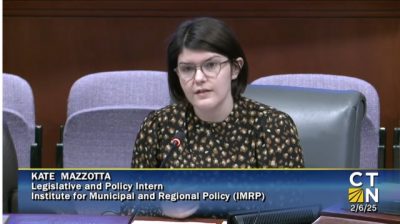
Her role extends well beyond a traditional research position. Having served as a previous tour guide at the Capitol, she offered behind-the-scenes tours to IMRP staff members and UConn School of Public Policy students, and led CTCIP’s efforts to increase its presence before the legislature, offering written and in-person testimony on several bills in support of children with incarcerated parents.
She’s also helped coordinate CTCIP’s hands-on programming inside Connecticut correctional facilities, including a winter family celebration at York Correctional Institution and a Father’s Day event at Osborn Correctional Institution. The events bring incarcerated parents together with their children for activities designed to support family connection and create more child-centered experiences within correctional settings.
At the Osborn event, Mazzotta saw firsthand why that work matters.
One father had not seen his five-year-old daughter in person since she was a baby. During the event, the two took photographs together.
“Having the opportunity to take pictures together means he now not only has lasting memories from the day, but he has a picture he can look at of his growing daughter until he sees her again,” Mazzotta says.
Another moment was even more ordinary: a toddler fell and cut her lip. Her father picked her up, comforted her and helped care for her.
“It was a typical parenting moment between a father and a child,” Mazzotta says. “The only difference is that it happened inside of a carceral facility.”
Policy is about people.
That distinction gets at the heart of Mazzotta’s work with CTCIP.
The initiative’s work includes policy and legislative advocacy, but its growing focus on family-centered programming is creating opportunities to see the impact of those policies more directly. CTCIP’s 2025 annual report highlighted expanded outreach, partnerships and hands-on programming, including child-friendly visiting spaces and family events inside correctional facilities.
Helping people understand the negative effects of parental incarceration is one step we can all take this month to raise awareness.
That perspective is particularly relevant in October, as CTCIP and its partners mark Parental Incarceration Awareness Month and continue efforts to raise awareness of the experiences and needs of children with incarcerated parents.
“CIPs are often overlooked when discussing the impact of the criminal legal system,” says Mazzotta. “Having a month dedicated to these kids gives all of us the chance to bring awareness not only to in-state efforts, but efforts around the country being made to help children with incarcerated family members. Helping people understand the negative effects of parental incarceration is one step we can all take this month to raise awareness.”
For Mazzotta, it is the latest chapter in an ongoing career managing a production, only on a different type of stage, one that she knows she’s meant to be on.
“Look at me,” she says. “A theater kid from a political family studies stage management and goes on to become a policy person advocating for children with incarcerated parents.”