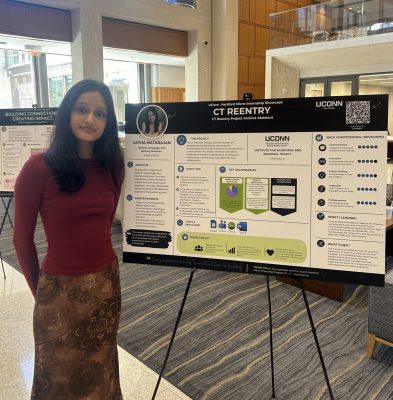
 For the second consecutive year, the Institute for Municipal and Regional Policy (IMRP) partnered with UConn Hartford’s Micro-Internship Program to provide an undergraduate student with hands-on professional experience supporting a public policy initiative with real-world impact.
This summer, Astha Natarajan, a rising sophomore majoring in Speech, Language, and Hearing Sciences, spent five weeks exploring Connecticut’s network of reentry services and the collaborative efforts that support individuals returning to their communities after incarceration.
Before beginning the project, Natarajan said she had only a limited understanding of the resources available to formerly incarcerated individuals. Through her work with IMRP, she gained a firsthand look at the partnerships, organizations, and community-based efforts that have shaped reentry services across Connecticut for more than a decade.
“I chose to work on the IMRP CT Reentry Archive Project because I think it’s very interesting to understand what goes into supporting incarcerated individuals when returning to their communities,” says Natarajan. “I learned so many new things that I wouldn’t have known prior.”
Working alongside special project consultant Mike Cronin, Natarajan conducted an extensive review of materials from the CT Reentry Collaborative website, last updated in 2022. Established as a statewide initiative connecting government agencies, nonprofit organizations, service providers, and community partners, the collaborative organized ten regional reentry roundtables that helped coordinate resources and support successful reentry efforts throughout Connecticut.
“People completing their sentences often return to their communities without housing, jobs, or healthcare,” says Cronin. “The less support they have, the more challenging they will find the transition. Reentry services ease their path and provide a hand up.”
The project challenged Natarajan to examine years of archived materials, including newsletters, publications, resource guides, partner information, and website content. She audited outdated resources, identified broken website links, and worked to consolidate information into a format that would be accessible to current audiences.
Her work culminated in a redesigned and expanded CT Reentry landing page on the IMRP website, transforming what was previously a brief, text-only web page into a more comprehensive resource documenting the history of IMRP’s involvement in the Collaborative and subsequent reentry initiatives.
“For someone without experience in this field, Astha was a quick study who worked on her own initiative. She clearly understood the scope of the project and maximized the time she had with us,” said Cronin.
Although Natarajan’s long-term goal is to become a speech-language pathologist through UConn’s 4+1 master’s program, she found that many of the skills she developed during the internship extend well beyond her chosen field. One of the most challenging aspects of the project was navigating the volume of information within the internship’s limited 60-hour timeframe.
“This opportunity definitely taught me a lot about a workplace environment and how to navigate it using my preexisting skills,” she says. “I also gained skills such as effective communication, collaborating with multiple stakeholders, and managing project deadlines. I will be able to apply these skills to any job I land in the future.”
The experience reflects the goals of UConn Hartford’s Micro-Internship Program, which combines professional experience with the development of eight career competencies, including critical thinking, teamwork, leadership, and technology. Through short-term projects with civic, nonprofit, and professional organizations, students gain practical experience while exploring potential career paths.
“If students are looking for a way to think about what life could look like after graduation, participating in this micro-internship program is going to create an open door for them to build a network of support both on the Hartford campus, in the community, and themselves,” says Joanna Rivera Davis, UConn Hartford’s Director of Success, Equity, and Inclusion.
The internship concluded with a student showcase in which participants presented their projects and reflected on their experiences and accomplishments.
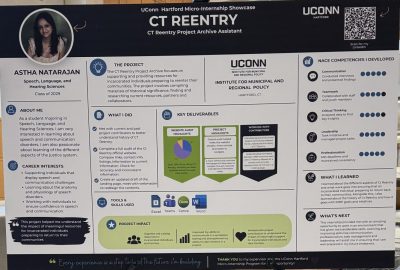
For IMRP, the partnership has proven mutually beneficial. In May of 2025, School of Public Policy student Fatima Ismail completed a similar archival project documenting the history of IMRP’s Building Bridges conferences, creating a comprehensive online resource featuring a project timeline and curated video playlist. Student workers from UConn’s Institutional Insight and Innovation (I3) program also provided technical assistance with website design and special features.
For students considering future micro-internships, Natarajan encourages them to take advantage of the opportunity.
“As a rising sophomore, I had little experience with internships,” she says. “While it is a more condensed internship timeline, the skills you gain are just as valuable.”
In addition to its graduate assistantships and summer internship opportunities, partnerships such as the UConn Hartford Micro-Internship Program allow IMRP to connect students with meaningful public policy projects while providing valuable support for ongoing Institute initiatives.