
CT Children with Incarcerated Parents (CTCIP), the Institute for Municipal and Regional Policy’s longest-running initiative, has received legislative funding since 2008, the first such legislatively funded statewide initiative of its kind in the country. We spoke with senior program manager Irvine Peck’s-Agaya about the initiative, her path to IMRP, and supporting children and families affected by incarceration.
Q1: October is Children with Incarcerated Parents Month. Why is this important?
When a parent is incarcerated, the impact extends to their children, caregivers, and families. Children may experience separation, changes in their daily routines, financial challenges, and stigma, often without people around them recognizing what they are navigating. They are part of our schools, libraries, neighborhoods, and communities, yet they are often underserved and overlooked. October gives us an opportunity to bring those experiences into view and strengthen awareness of available support, and we want that awareness to shape the support these children receive throughout the year.

Q2: How will CTCIP acknowledge the month?
We have planned a variety of activities, including social media campaigns highlighting resources we’ve developed and resources from partners, library displays, supporting materials for schools, and amplifying national programs. The month will culminate with the CTCIP Symposium on October 22, our first ever, focused on embracing family connections and highlighting the voices of children and youth with incarcerated parents. We’re bringing together people with lived experience, practitioners, community partners, and policymakers to explore the importance of these relationships and the complexities involved in supporting them. My hope is that participants leave with a deeper understanding of children’s experiences and a clearer sense of their role in supporting families.
Q3: What does CTCIP do throughout the year?
Our work continues year-round through training and technical assistance for agencies, educators, and community partners, research and policy engagement, scholarships for UConn students, and family activities.
We work with correctional facilities and DCF to improve child-friendly visiting spaces and create opportunities for families to connect. We’re planning our second annual family celebration at York Correctional Institution in January 2027, with a toy drive running from late October through December. Earlier this year we had a Father’s Day event at Osborn. These activities give children and parents opportunities to play, talk, and share time together in a normalized environment.

Q4: Why is this work meaningful to you?
What makes this work meaningful to me is the opportunity to connect changes in systems with something very personal in a child’s life. A visiting space, a school’s response, or access to a resource can influence whether a child feels supported and included. As a mother, I also think about how much children depend on everyday moments of connection: sharing a meal, reading together, playing, or simply having someone listen. This work reminds me to keep those experiences at the center of our decisions while working toward lasting improvements in policy and practice.
Q5: Tell us about how you came to IMRP.
I joined IMRP in August 2021, right after graduating from UConn’s Higher Education and Student Affairs program. I had been seeking roles in student advising and student support. As an undergraduate, I spent a lot of time working with Wesleyan’s prison education and entrepreneurship programs to leverage social entrepreneurship to support people convicted of drug offenses. So much of that was inspired by my personal experiences seeing how incarceration impacted my family.
When I found CTCIP at IMRP, it was the first time I saw parental incarceration addressed without stigma. I found people who wanted to be part of the solution and address the collateral impact of incarceration on children and families through policy. I was immediately sold. I was brought on as a program assistant at that time and then later moved into an operations role, supporting all IMRP initiatives across the board, before earning the opportunity to run a project on my own.
Q6: CTCIP isn’t the only program you’re part of at IMRP. You lead and support a number of initiatives. Tell us about them.
I also oversee ReConnect CT: Digital Pathways, which focuses on expanding digital literacy and workforce readiness for people impacted by the justice system. Through partnerships with libraries, educational institutions, and community organizations, we help people build skills to navigate employment, education, services, and everyday tasks. I also have a pulse on the International Justice Exchange program.
Last academic year and this year, I’ve been leading a mentorship program with Jacob Werblow, in partnership with UConn’s Human Development and Family Science department and the Connecticut Judicial Branch’s Juvenile Residential Services. The program pairs college students with youth in secure, treatment-based residential settings to build prosocial relationships, increase exposure to higher education, and support youth development.
Q7: While you’re managing multiple projects, you’re also completing your MBA at UConn – your second master’s degree – and you are the mother of a young child. How do you balance your many priorities?
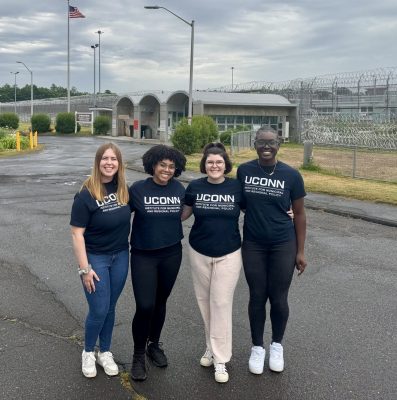
Good question! I often wonder that myself. I try to be intentional about my time, realistic about what I can accomplish, and clear about what needs my attention most. I’m also learning to ask for support and recognize that everything cannot receive the same level of attention at the same moment.
I have a great team here of high-achieving, thoughtful, and caring individuals, each of whom brings a unique blend of experience to the project. I appreciate that everyone brings their perspectives and energy to the work.
As for my studies, I’m in my final semester of the MBA, and I appreciate being able to apply what I’m learning to my work, including project management, fiscal and strategic planning, and organizational leadership. Being a student, a program manager, a spouse, and a mom gives me different perspectives on responsibility and growth.
Q8: Since 2014, the CTCIP scholarship has awarded more than 25 scholarships totaling over $75,000 to students impacted by the incarceration of a close family member. Why is the program important, and what success have you seen?
The scholarship addresses a financial need while recognizing an experience that can be overlooked in higher education. Since we’re located at a university, it’s also a great way to give back, show our presence on campus, and get students involved.
Recipients have described feeling recognized, encouraged in their studies, and motivated to help other students in the future. Those reflections speak to the importance of both financial support and a sense of belonging. Several of our recipients will actually be panelists at the symposium.

Q9: What are CTCIP’s priorities in the year ahead and what are you most proud of?
In the year ahead, our priorities are to expand funded programs designed around the needs of children with incarcerated parents, continue providing resources, and establish an advisory group that includes people with lived experience, state agencies, and community partners to help guide our work. With additional funding, we can support more services while continuing our work with DOC to improve child-friendly visiting spaces, inform policies, and create opportunities for family engagement.
I am most proud of the child-friendly engagement events we’ve created for children and their incarcerated parents, and our work with the legislature to secure additional funding for programs that support these families. That investment reflects trust in our work and a shared commitment to children with incarcerated parents.
Q10: Outside of UConn Gives, the university’s annual fundraising day, how else can the public support CTCIP?
I would encourage people to consider where children with incarcerated parents may already be present in their work and communities. You do not need to work in the justice system to make a difference. A teacher, librarian, coach, or community member can help by responding without judgment and respecting a child’s privacy. Children deserve to be understood as whole people, with their own interests, relationships, and hopes for the future, and not stigmatized by their parents’ behaviors. I hope October encourages people to carry that understanding into their everyday interactions throughout the year.
To learn more, visit https://ctcip.org/.