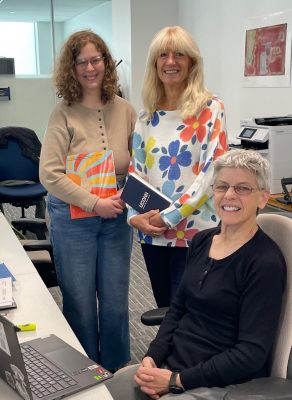
They come to the University of Connecticut School of Social Work from universities across Connecticut and the Northeast, and as far away as California and England.
Their professional backgrounds are just as varied: corporate social responsibility, child welfare, and stage management.
Some are pursuing joint degrees in social work and public policy. One is a 35-year veteran of the corporate world. Another, a veteran of the U.S. Army.
What do they have in common?
They are among the UConn Master of Social Work students who have found their way to the Institute of Municipal and Regional Policy (IMRP) in the School of Public Policy, where their required practicum experiences give them an opportunity to contribute to policy research and legislative issues affecting Connecticut communities, particularly those involving criminal justice work.
For IMRP, the relationship is a natural extension of the Institute’s long-standing student internship program. Each year, IMRP brings undergraduate and graduate students into its research and policy work, providing opportunities to gain practical experience in key initiatives including the Connecticut Sentencing Commission, Children with Incarcerated Parents Initiative, the International Justice Exchange, and additional legislative priorities.
It’s a particularly logical fit for MSW students concentrating in policy practice.
The concentration prepares students to examine the systems and policies that shape people’s lives, developing skills in policy analysis, research, advocacy, program evaluation, and legislative policy work. It is social work practiced at the macro level, with an emphasis on using policy to address inequality and advance more equitable outcomes.
Bringing different experiences to policy
Diane Cantello is no stranger to the working world.
Cantello is a second-year MSW student concentrating in macro policy and international social work. Before returning to school, she spent 35 years in the corporate world, leading corporate responsibility, social impact, communications and marketing functions for companies including Stanley Black & Decker, The Hartford, and Cigna.
“I reached a point in my corporate career where I felt I had achieved what I wanted to and welcomed the opportunity to change my focus,” she says. “Coming back to academia was something I always had in the back of my mind.”
The opportunity to study social work with a macro focus, she says, was particularly compelling.
“I was looking for an internship opportunity with a macro perspective to look at ways policy can create systemic change for vulnerable populations,” Cantello says.
At IMRP, Cantello is supporting the Institute’s International Justice Exchange, where she is gaining exposure to criminal justice and reentry policy reform.
“The chance to look at things from an international and global perspective makes this work very interesting,” she says.
For Susan Camoroda, the connection between prior experience and current internship is far more direct.
A retired U.S. Army veteran, Camoroda received her MPA through the School of Public Policy’s Executive Fellows program. She’s now working on her MSW with a policy practice concentration at UConn. At IMRP, she is contributing to state-level studies related to military and veterans’ affairs under the direction of Lydia Wileden, assistant research professor.
“These projects connect directly to my military experience,” she says. “It’s meaningful to help identify ways the state can better support those who have served and it allows me to continue to serve.”
For more about Susan Camoroda’s 30 years of commissioned service, read From Service to Scholarship.
Stav Keshet, a joint MPP/MSW candidate, came to UConn with a background in political theory, social movements and qualitative research from Mount Holyoke College. Her interests in criminal legal reform helped her obtain a graduate assistant position with the IMRP upon entering her public policy studies.
“I’ve always been a government and policy person,” Keshet says, of her decision to pursue the joint degree. “I was interested in getting that value-based perspective and examining policy and research from a human-based approach.”
At IMRP, Keshet supports research initiatives related to correctional officer well-being, contributing to internal reports and policy briefs for the legislative session.
“If you’re a macro social work student, there are a lot of different projects at the IMRP that can provide exposure to social justice and service,” she says. “You can engage with the public and with the community, you can have exposure to the legislature, and you can be in a number of spaces, to see how things happen here.”
Connecting experience to impact
For Lorien Velasquez, the opportunity to work at IMRP connects two areas of her professional experience.
A second-year MSW student concentrating in policy practice, Velasquez earned her bachelor’s degree in psychology from Central Connecticut State University before beginning her career with the Connecticut Department of Children and Families. She later became a supervisor and then joined the Connecticut Judicial Branch as an adult probation officer.
Her professional experiences have shaped her interest in child welfare and the criminal justice system, particularly the ways those systems affect children and families.
“I saw the impact that the children with parents who were in the system had on their upbringing, development, and overall self-esteem,” she says. “I wanted to be part of these tough conversations, especially being able to resonate with my own life experiences as a social worker and as an adult probation officer.”
At IMRP, Velasquez is supporting the Connecticut Children with Incarcerated Parents initiative.
“The IMRP has different programs and initiatives that have a strong impact on today’s society,” she says.
That variety is part of what makes the Institute a valuable practicum setting for students whose interests may span multiple policy areas.
Practicum education is an integral part of UConn’s MSW curriculum. Students complete two practicum placements, with advanced-year students completing placements focused primarily on their chosen concentration. Current requirements call for students in the Hartford MSW program to spend between 17 and 20 hours a week at their practicum placement during the academic year.
For policy practice students, the practicum hours provide an opportunity to move beyond studying policy in the classroom to participating in the work itself.
Where an internship can lead
That experience can also open doors to future opportunities. 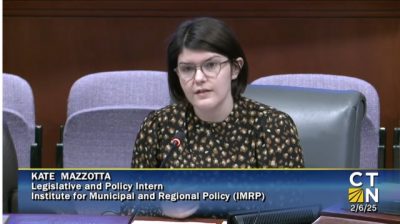
Kate Mazzotta was the third MSW student to intern with IMRP and the first to turn the experience into full-time employment. She arrived with an unconventional background for a policy researcher: a bachelor’s degree in Theater and Speech from Wagner College, with a concentration in Design, Technology and Management.
“Policy was always in the back of my mind while at Wagner,” she says. “I chose government and sociology classes as electives. I just never connected the dots.”
During her third year of MSW studies, Mazzotta completed a practicum with the IMRP where she supported CT Children with Incarcerated Parents, working to build a stronger presence at the legislature by offering in-person testimony in support of child-friendly legislation. She’s since been hired as a full-time IMRP employee as a policy and research associate on the CTCIP team.
“There’s a natural flow to policy and social work,” says Mazzotta. “Macro policy people are community organizers. They run grassroot campaigns. They write social welfare policy. Social work is influenced by state and national policies.”
For current MSW students considering where their practicum might lead, Mazzotta has simple advice.
“Figure out where the opportunities are,” she says. “While the Practicum office will help with placements, you can look for your own opportunities. Always ask questions, do your research, and don’t rely on just your classes and your professors. Advocate for yourself as if you were a client.”
Learn more about the IMRP here: https://imrp.dpp.uconn.edu/