Skip to Navigation Skip to UConn Search Skip to Content

UConn Cookie Information

Web cookies (also called HTTP cookies, browser cookies, or simply cookies) are small pieces of data that websites store on your device (computer, phone, etc.) through your web browser. They are used to remember information about you and your interactions with the site.

Purpose of Cookies:

  1. Session Management:

    • Keeping you logged in

    • Remembering items in a shopping cart

    • Saving language or theme preferences

  2. Personalization:

    • Tailoring content or ads based on your previous activity

  3. Tracking & Analytics:

    • Monitoring browsing behavior for analytics or marketing purposes


Types of Cookies:

  1. Session Cookies:

    • Temporary; deleted when you close your browser

    • Used for things like keeping you logged in during a single session

  2. Persistent Cookies:

    • Stored on your device until they expire or are manually deleted

    • Used for remembering login credentials, settings, etc.

  3. First-Party Cookies:

    • Set by the website you're visiting directly

  4. Third-Party Cookies:

    • Set by other domains (usually advertisers) embedded in the website

    • Commonly used for tracking across multiple sites

Authentication cookies are a special type of web cookie used to identify and verify a user after they log in to a website or web application.


What They Do:

Once you log in to a site, the server creates an authentication cookie and sends it to your browser. This cookie:

  • Proves to the website that you're logged in

  • Prevents you from having to log in again on every page you visit

  • Can persist across sessions if you select "Remember me"


What's Inside an Authentication Cookie?

Typically, it contains:

  • A unique session ID (not your actual password)

  • Optional metadata (e.g., expiration time, security flags)

Analytics cookies are cookies used to collect data about how visitors interact with a website. Their primary purpose is to help website owners understand and improve user experience by analyzing things like:

  • How users navigate the site

  • Which pages are most/least visited

  • How long users stay on each page

  • What device, browser, or location the user is from


What They Track:

Some examples of data analytics cookies may collect:

  • Page views and time spent on pages

  • Click paths (how users move from page to page)

  • Bounce rate (users who leave without interacting)

  • User demographics (location, language, device)

  • Referring websites (how users arrived at the site)

Here’s how you can disable cookies in common browsers:

1. Google Chrome

  • Open Chrome and click the three vertical dots in the top-right corner.

  • Go to Settings > Privacy and security > Cookies and other site data.

  • Choose your preferred option:

    • Block all cookies (not recommended, can break most websites).

    • Block third-party cookies (can block ads and tracking cookies).

2. Mozilla Firefox

  • Open Firefox and click the three horizontal lines in the top-right corner.

  • Go to Settings > Privacy & Security.

  • Under the Enhanced Tracking Protection section, choose Strict to block most cookies or Custom to manually choose which cookies to block.

3. Safari

  • Open Safari and click Safari in the top-left corner of the screen.

  • Go to Preferences > Privacy.

  • Check Block all cookies to stop all cookies, or select options to block third-party cookies.

4. Microsoft Edge

  • Open Edge and click the three horizontal dots in the top-right corner.

  • Go to Settings > Privacy, search, and services > Cookies and site permissions.

  • Select your cookie settings from there, including blocking all cookies or blocking third-party cookies.

5. On Mobile (iOS/Android)

  • For Safari on iOS: Go to Settings > Safari > Privacy & Security > Block All Cookies.

  • For Chrome on Android: Open the app, tap the three dots, go to Settings > Privacy and security > Cookies.

Be Aware:

Disabling cookies can make your online experience more difficult. Some websites may not load properly, or you may be logged out frequently. Also, certain features may not work as expected.

UConn University of Connecticut
Search University of Connecticut Search UConn
Site A-Z

UConn A-Z

School of Public Policy

Institute for Municipal and Regional Policy
Search this Site
Institute for Municipal and Regional Policy
  • Home
  • About Us
    • Mission
    • Personnel
    • Strategic Plan
    • Work with Us
  • Our Work
    • Current Initiatives
      • ReConnect CT: Digital Pathways Program
      • Children with Incarcerated Parents Initiative
      • Connecticut Racial Profiling Prohibition Project
      • Connecticut Sentencing Commission
      • International Justice Exchange
      • Commission on Racial and Ethnic Disparity
      • The Pew-MacArthur Results First Initiative
    • Past Projects
      • Building Bridges
      • Police transparency and accountability task force (PT&ATF)
      • Justice Reinvestment
      • On the Outside
      • Release News
      • Youth Violence Prevention: New Haven
  • News and Events
    • News
    • Past Events
  • Library
    • Publications
    • Videos
Search this Site

From Campus to the Capitol: UConn Student is One Face of the Future of Civic Engagement in Connecticut

February 3, 2026

Following last week’s sold-out Connecticut Forum event: On Democracy and the Future of the Parties: Pete Buttigieg in Conversation with Jonah Goldberg at The Bushnell, the UConn School of Public Policy and the Institute for Municipal and Regional Policy (IMRP) once again partnered with the Connecticut Forum to host a “Forum Encore!” event. 

The Encore event was designed to take the initial conversation – and the SPP/IMRP simulcast of the event – to the next level by focusing specifically on civic engagement in Connecticut and the role students and communities play in shaping public life. 

The free community discussion, titled “From Campus to the Capitol: The Future of Civic Engagement in Connecticut,” was held on Tuesday, February 3rd, at the Hartford Public Library. The event was moderated by Frankie Graziano of The Wheelhouse on Connecticut Public and featured a panel that brought together state leaders and a student with firsthand experience in civic engagement. 

Panelists included:

  • Secretary of the State Stephanie Thomas 
  • Former Senate Minority Leader Len Fasano 
  • UConn student leader Ryan Engels 

Engels, a political science major (CLAS ‘27) and School of Public Policy Fast-Track MPA student, recently completed an internship with IMRP, where he worked with Associate Director Ken Barone, who also serves as project manager for the Connecticut Racial Profiling Prohibition Project (CTRP3). Part of Engels’ work involved collecting and organizing data from Inspector General Use of Force Reports to help inform State’s Attorneys and IMRP on police use of force statewide. He was selected to participate in the Forum Encore event given his early involvement in and passion for local and student government. 

UConn junior Ryan Engels is a School of Public Policy MPA Fast-Track student

In addition to his work with IMRP, Engels was recently elected as a Zoning Commissioner in his hometown of Westbrook where he also serves as Chairman of the Sustainability Committee. As a freshman at UConn, he founded the Connecticut Youth Political Advocacy Center (CYPAC) from his dorm room. The organization is a nonpartisan nonprofit dedicated to promoting civic engagement and youth participation at the state and local levels of government. Engels has also served as a senator in the UConn Storrs Undergraduate Student Government and as Executive Vice President of College Democrats of Connecticut. 

Read more in our Intern Spotlight: 10 Questions with Ryan Engels

IMRP Director and School of Public Policy adjunct faculty member Andrew Clark brought students from his Public Policy 1001 course to attend the discussion, reinforcing the program’s focus on connecting classroom learning with real-world civic engagement. 

During the conversation, Secretary Thomas described civic engagement broadly, defining it as anything from everyday actions like “not throwing trash out your window, picking it up instead,” to more formal participation such as running for public office. 

Engels acknowledged that sharing the stage with long-serving Connecticut leaders was initially intimidating. Still, he emphasized that there are no prerequisites for making a difference. “I tell other young people and students interested in getting involved, you belong in these spaces. If you have the motivation and dedication to the causes that you feel strongly about, you can make an impact – no matter your age.”

If you have the motivation and dedication to the causes that you feel strongly about, you can make an impact – no matter your age.

Thomas echoed that sentiment, stressing the importance of encouraging young people to exercise agency now rather than waiting until later in life. Former Senate leader Fasano, who currently serves on the Connecticut Sentencing Commission, added that many traditional entry points into politics lack younger participation. He noted that the average age of town committee members he has worked with is 68. 

“Town committees are the epicenter for people who want to go into politics,” Fasano said. “That’s a place you can plug into and the quickest place you can make a change, but I don’t see a lot of younger people getting on these committees and putting the time in. Then it’s tough to not put the time in and complain later.” 

Thomas also emphasized that while many issues feel national in scope, change often happens locally.“Unless you know where to intersect in government and put your energies, you can get frustrated, and that’s where civic education comes in,” she said. She suggested everyone visit The Power of Civics free online training available on the ct.gov website. 

Fasano reflected on what he sees as a growing disconnect between younger generations and government. “Seems to me that there might be more disenfranchisement and disconnect with the younger generation,” he said. “They have to change that energy to a positive energy. Being upset about it doesn’t create change. Having input and having a conversation with their politicians to have a dialogue to effectuate change does.” 
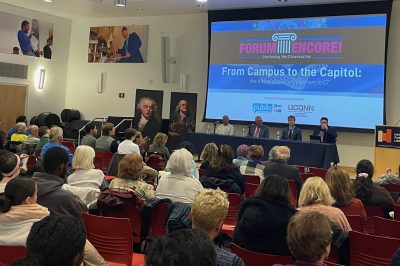
The panelists addressed a full room at the Hartford Public Library

“Young people are disillusioned,” Engels agreed. “Young people too often rely on social media for their engagement. We can get into the habit of seeing each other as usernames rather than having human conversations. Getting back to having conversations like these is important.” 

Engels highlighted an upcoming debate between UConn College Democrats and UConn College Republicans at the Dodd Center for Human Rights on Thursday, February 5th as a sign of constructive engagement. “Young people can engage in respectful civil discourse,” he said. 

To close the discussion, Graziano asked panelists to share a small but meaningful step audience members could take to become more civically engaged. Engels offered advice tailored to different generations. For students, he encouraged joining youth advisory boards aligned with their interests, noting that these spaces benefit from youth voices. For older community members, he suggested mentoring students, describing the impact as potentially life changing. 

Georgia LoPresti, a student in Clark’s Public Policy 1001 course, said she appreciated seeing multiple generations represented on the panel. Of Engels, she noted, “He held his own. At a young age, he’s already doing so much. It’s encouraging for other students to see.” 

School of Public Policy Director Angie Eikenberry, who also provided welcome remarks, and UConn Hartford Campus Dean Mark Overmyer-Velázquez, both noted the strong student turnout and proximity of the campus to the State Capitol building as opportunities for further learning and engagement.


Posted by Gordon in CTRP3, Featured News and tagged #civic engagement, #civics, #CTForum, #government, #IMRP, #politics, #SPP, #students
← Previous
Next →

Archives

  • March 2026
  • February 2026
  • January 2026
  • December 2025
  • November 2025
  • October 2025
  • September 2025
  • August 2025
  • July 2025
  • May 2025
  • April 2025
  • March 2025
  • February 2025
  • January 2025
  • December 2024
  • November 2024
  • October 2024
  • September 2024
  • August 2024
  • July 2024
  • June 2024
  • May 2024
  • October 2023
  • June 2022
  • May 2022
  • April 2022
  • December 2021
  • April 2021
  • February 2021
  • October 2020
  • July 2020
  • June 2020
  • May 2020
  • April 2020
  • March 2020
  • February 2020
  • November 2019
  • September 2019
  • June 2019
  • February 2019
  • December 2018
  • April 2018
  • March 2018
  • September 2017
  • May 2016
  • January 2016
  • June 2015
  • April 2015
  • September 2014
  • January 2014
  • November 2012
  • October 2010
  • February 2010
  • March 2008
  • January 2008
  • January 2006
  • January 2003

Categories

  • Building Bridges
  • CIP
  • CT Reentry
  • CT Sentencing Commission
  • CTRP3
  • Featured News
  • Film Fridays
  • IJE
  • IMRP Events
  • IMRPUConn
  • Make It Happen
  • Norway Shares Its Model of Success
  • One Film
  • One State
  • Past Events
  • Public Dialogue Series
  • Public Forums
  • Racial Profiling Prohibition Project
  • ReConnect CT
  • Reentry During the COVID-19 Pandemic Web Series
  • The Criminal Justice Insider Podcast
  • Theater Thursdays
  • Uncategorized
Search this Site
UConn Institute for Municipal and Regional Policy
  • Facebook
  • LinkedIn
  • YouTube

Contact Us

E-mail: imrp@uconn.edu
Address: UConn Hartford
Hartford Times Building, Room 443
10 Prospect Street
Hartford, CT 06103
  • © University of Connecticut
  • Disclaimers, Privacy & Copyright
  • Accessibility
  • Webmaster Login
  • A-Z Index